
Magazine · Case study — Cape Town
Built to be owned: Cape Town's seawater plant, seven years on
In 2019 a Cape Town hotel sank a 100-metre borehole beneath itself and began turning seawater into drinking water. The plant is still running seven years later — not because nobody touched it, but because it was built for the people who would run it.
What was built
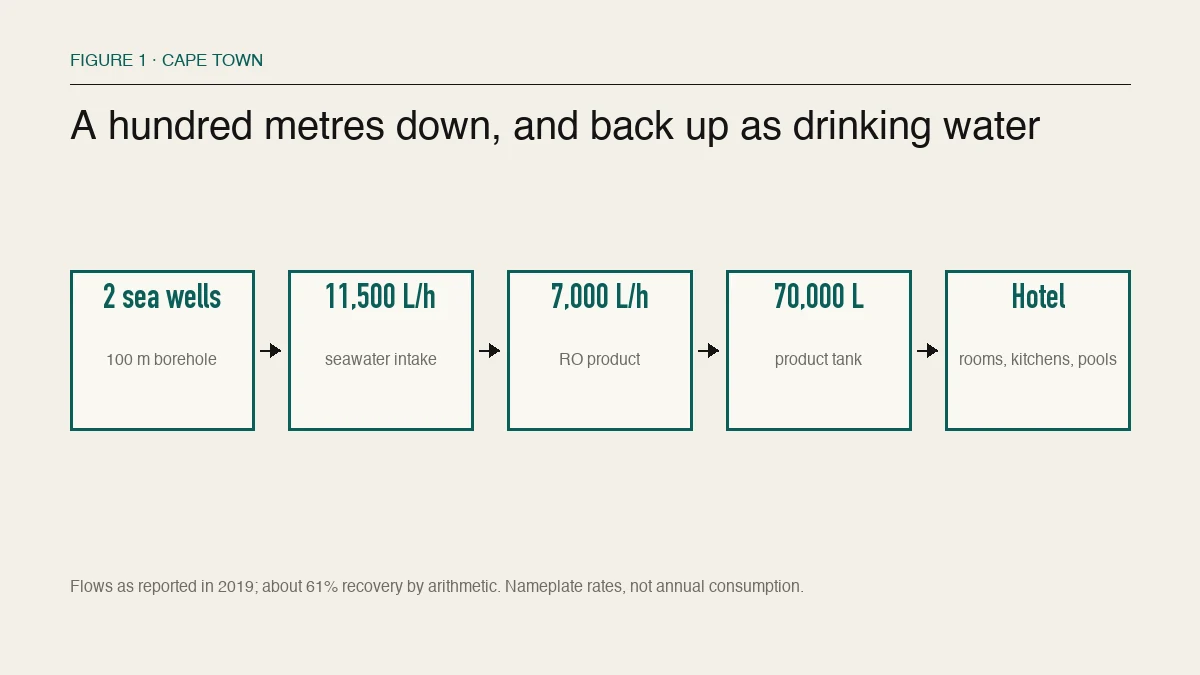
In 2019 the engineering team at the Radisson Collection Hotel, Waterfront Cape Town — then the Radisson Blu — drilled a 100-metre borehole beneath the building to reach seawater, and built a desalination plant around it. The hotel had 177 rooms at the time, 175 after its 2024 refurbishment.17
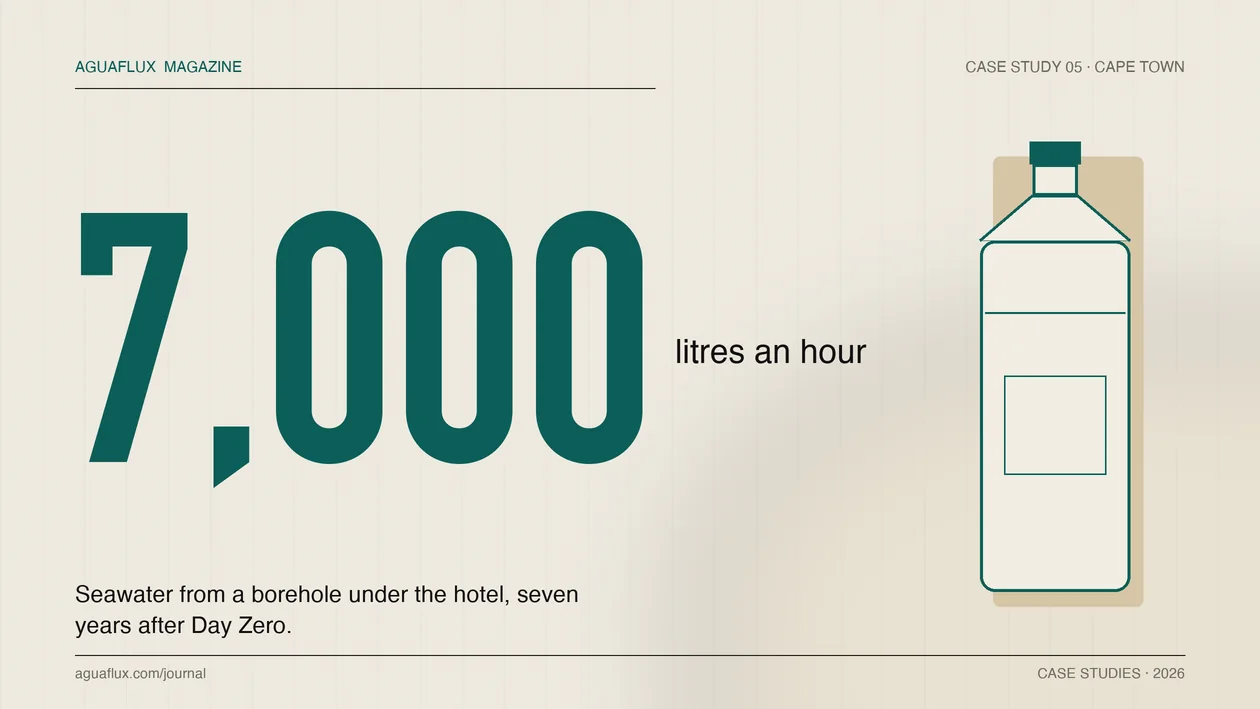
The published numbers are unusually specific. The intake lifts up to 11,500 litres of seawater an hour; the plant produces 7,000 litres an hour of fresh water into a 70,000-litre tank — about ten hours of output as buffer.2 The plant was designed in-house by the hotel's chief engineer rather than bought as a package.3
The crisis it answered
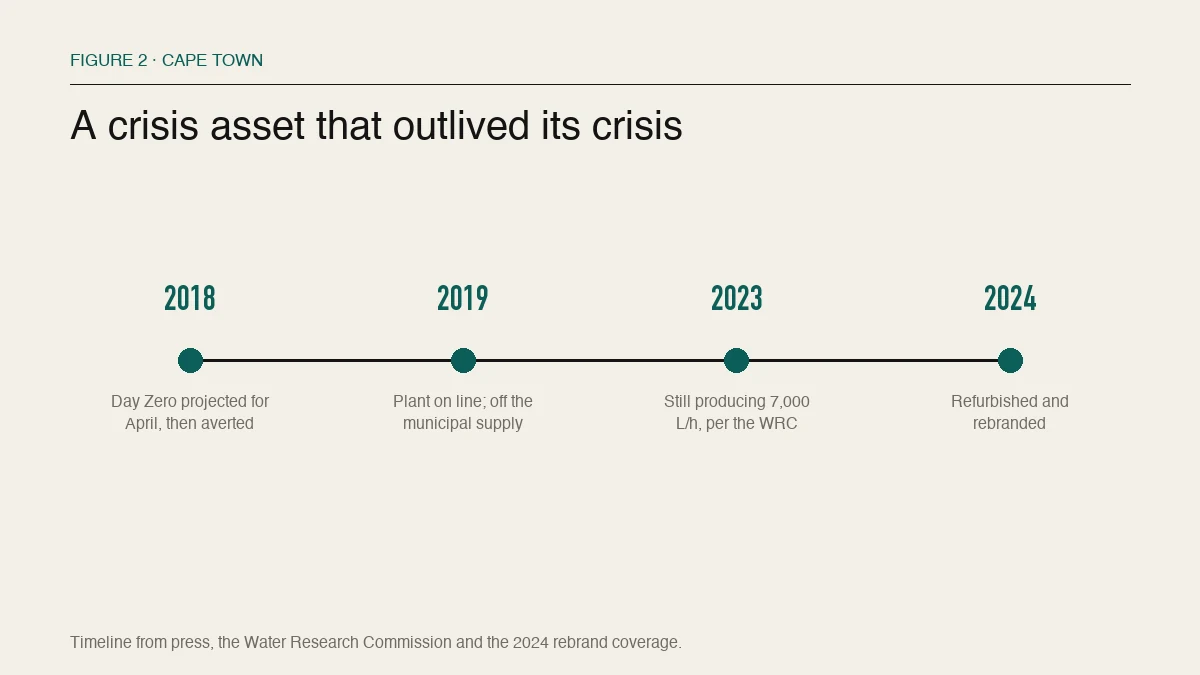
Cape Town's Day Zero was projected for 12 April 2018 and averted.4 By April 2019, with restrictions relaxing from level 5 to level 3, the hotel was reported to have gone further: it had disconnected from the municipal drinking-water network and would source its supply from its own plant.5 The general manager's framing: guests “can rest assured that they are not putting pressure on local water supply”.1
Read that as an operator claim, not an audited fact. No source shows the connection was physically removed, and a hotel can run its own plant while keeping mains as backup. The defensible version is: reported to operate off the municipal drinking-water supply.
Why it survived
Most crisis equipment is abandoned when the crisis passes. In 2023 — dams full — South Africa's Water Research Commission described the plant as still producing about 7,000 litres an hour.6 Four things explain that:
- It was designed by the people who run it. An engineer who owns the plant is a different maintenance culture from a contractor who owns a service contract.
- It replaced an operating cost, not just a risk. Tariffs rose sharply through the drought; every cubic metre made is one not bought.
- It was sized to the building. 7,000 litres an hour against a 70,000-litre tank can run part-time and still keep the hotel wet.
- It sits on the sea. Inland hotels cannot copy this; coastal ones can.
The contractor question
It would be easy to read this as a case against contractors. That is the wrong lesson. Most hotels do not have a chief engineer who can design a seawater RO plant, and the plants that fail are rarely failed by the people who built them — they fail because nobody was handed the knowledge to run them.
What matters is the handover. A good contractor designs with the property's engineer, commissions with measured data, trains the team who will actually be on shift at 2am, documents the plant in the building it sits in, stocks the spares that fail first, and signs a service agreement that transfers capability rather than creating dependency. The goal is not a contract that never ends; it is a plant your team can run, with someone competent to call.
That is the model AGUAFLUX works to: specify, install, commission, train, document, then support — with the asset and the know-how left on site. A borehole, a membrane train and a tank are not the hard part. Making them someone's responsibility for the next decade is.
What the record does not show
No capital or operating cost is public. No water-quality data — conductivity, boron, chloride, microbial — is published. And nameplate is not consumption: 7,000 litres an hour running continuously would be about 168 m³ a day, but actual production follows hotel demand, which is unknown.
What we would audit
- Actual daily demand, split by rooms, F&B, laundry, pools and irrigation.
- Normalised RO performance, with a membrane replacement forecast.
- Intake and pre-treatment condition, with cartridge and media trends.
- Water-quality compliance at the tap, including boron and chloride.
- Energy per cubic metre, brine compliance, and a written outage plan.
Sources
All accessed November 2026. Quotations are from the linked pages.
- Bizcommunity, Cape Town hotel goes off the water grid, 1 April 2019: chief engineer Gary Bowers on the borehole and plant; general manager Clinton Thom quoted.
- TimesLIVE, Luxury Cape Town hotel gets off the water grid with new desalination plant, 8 April 2019: 11,500 L/h intake, 7,000 L/h product, 70,000 L tank.
- Green Building Africa, Cape Town hotel installs own seawater desalination plant, 24 May 2019: 100 m borehole, 7 m³/h, in-house design, disconnection from the municipal network.
- News24, Cape Town gears up for Day Zero, 28 January 2018: Day Zero projected for 12 April 2018.
- Green Building Africa (as above) and Cape Town ETC, hotel goes off the water grid, 9 April 2019.
- Water Research Commission, Water Wheel, May/June 2023, report record: the hotel's plant described as still producing about 7,000 litres an hour in 2023.
- Business Traveller, Radisson Collection debuts in South Africa, 16 December 2024: rebrand and 175 rooms after refurbishment.
Disclaimer. AGUAFLUX was not the supplier for the installation described here, and no commercial relationship with the property is implied. This case study is compiled from publicly available sources, all linked above; the figures are as published by those sources, and where a number is not public we say so rather than estimate it.
Coastal property, municipal risk?
Send us the demand profile, the plant room photos and any water analysis you have. We will tell you whether a plant, a service contract or a smaller hybrid is the right answer — and what it costs per cubic metre.