
Magazine · Villas & water supply
Villa water in Bali: municipal supply, wells and pre-filtration
Water in a Bali villa mostly arrives from two sources, and both have predictable failure modes. Understanding which one you have — and why pre-filtration comes first — decides whether the system works for a decade or a season.
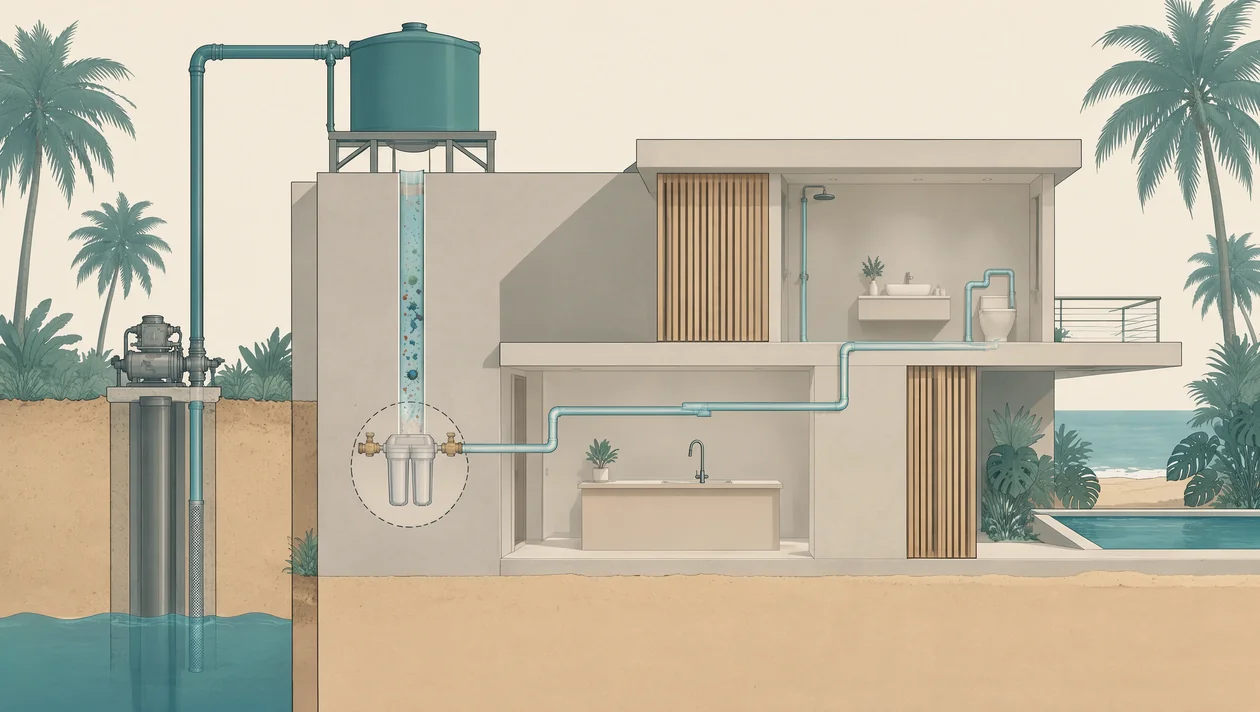
Municipal supply (PDAM)
A PDAM connection is not a guarantee of pressure or continuity. In much of south Bali, supply is intermittent: water doesn't arrive for some parts of the week, at a pressure that varies with elevation and with how many neighbours are drawing at once. The practical consequences are all upstream of the filter:
- Low pressure at the tap means the villa stores water in a tank and pumps from it — so coarse pre-filtration goes in front of the tank, and the fine filtration (AGUAFLUX) after it, not at the meter.
- Intermittent supply creates the conditions for back-siphonage and for sediment to resuspend when the main refills after an outage.
- Chlorine residual varies massively. Rarely exists or only protects the main; certainly it does not protect the water after it enters a tank for several days.
A tank can solve the pressure issue. It does not improve quality: an open or poorly sealed tank is a settling chamber and, in a tropical climate, a warm one. Water that leaves the treatment plant in acceptable condition can leave the tank worse.
Well and bore water
Shallow bores are common on villas outside the mains network, and their water quality is a function of what is nearby. Three problems recur:
Turbidity spikes after heavy rain are normal: the first flush carries soil and organic matter into the bore, and it is precisely the moment when a filter without a coarse first stage loads up and forces the pressure down.
Bacteria and recontamination
WHO estimates that at least two billion people use a drinking-water source contaminated with faeces — and that contaminated water is estimated to cause hundreds of thousands of diarrhoeal deaths a year. In Bali, peer-reviewed surveys of shallow wells and springs in the Denpasar and Badung areas have repeatedly reported E. coli and total coliforms above WHO guideline values, particularly in dry-season low-flow conditions and near septic infiltration.
The less discussed half of the problem is recontamination after treatment. Water that is safe at the point of filtration can pick up contamination in a storage tank, in a dead-leg of pipework, or through a cracked suction line. Biofilm in warm, intermittently used pipes — guest bathrooms that sit empty for weeks — is the classic villa case.
This is why a filtration system without attention to storage is an incomplete solution. Tank hygiene, a closed system, and a filter placed after storage matter as much as the cartridge specification.
Why pre-filtration comes first
Every subsequent stage is rated at a pore size, and every pore is protected by what precedes it. A carbon block behind an unfiltered feed will be blinded by silt within weeks; its capacity is consumed by sediment rather than by the compounds it exists to remove.
Pre-filtration — typically a filtration tower plus a 20 µm sediment filter if the water comes from the well — does four things at once:
- Protects downstream cartridges — the fine stages stay functional far longer.
- Absorbs turbidity spikes — the load from a post-rain first flush lands on a cheap cartridge.
- Stabilises pressure loss — a predictable service interval instead of a sudden drop.
- Reveals what is in the water — a cartridge's colour after two weeks tells you whether you are dealing with rust, silt or plastic particles.
Putting a system together
A defensible whole-house sequence for a Bali villa looks like this: coarse pre-filtration (10–20 µm) in front of the tank; then, after the tank, the fine stages — carbon, a final particle stage for sand and rust — and, where bacterial risk is material and the source is a shallow well, a disinfection bacterial-block stage sized for the peak flow. Fit a bypass loop so a filter issue does not take the house off water for days, which is dangerous for the tank and the pipes downstream.
None of it substitutes for source protection. Filtration is the last barrier, and the cheapest gains that will save your bill for cartridges usually sit before the filter: a sealed and shaded tank, a properly cased bore, regular flushing, and a clear maintenance interval someone will actually keep.
References
World Health Organization, Guidelines for Drinking-water Quality, 4th edition including the 2022 addendum. WHO, Water Safety Plan Manual, 2nd edition, 2023. WHO fact sheet, Drinking-water, 2022. Peer-reviewed surveys of shallow groundwater and springs in Denpasar and Badung, Indonesia (coliform contamination). Studies of seawater intrusion into coastal aquifers in south Bali.
Specify a system for your property
Send the source type, bathroom count and a photo of the plant room — we size it and quote the installed system.