
Magazine · Waste & water
The waste problem behind the postcard: Bali, Mexico and beyond
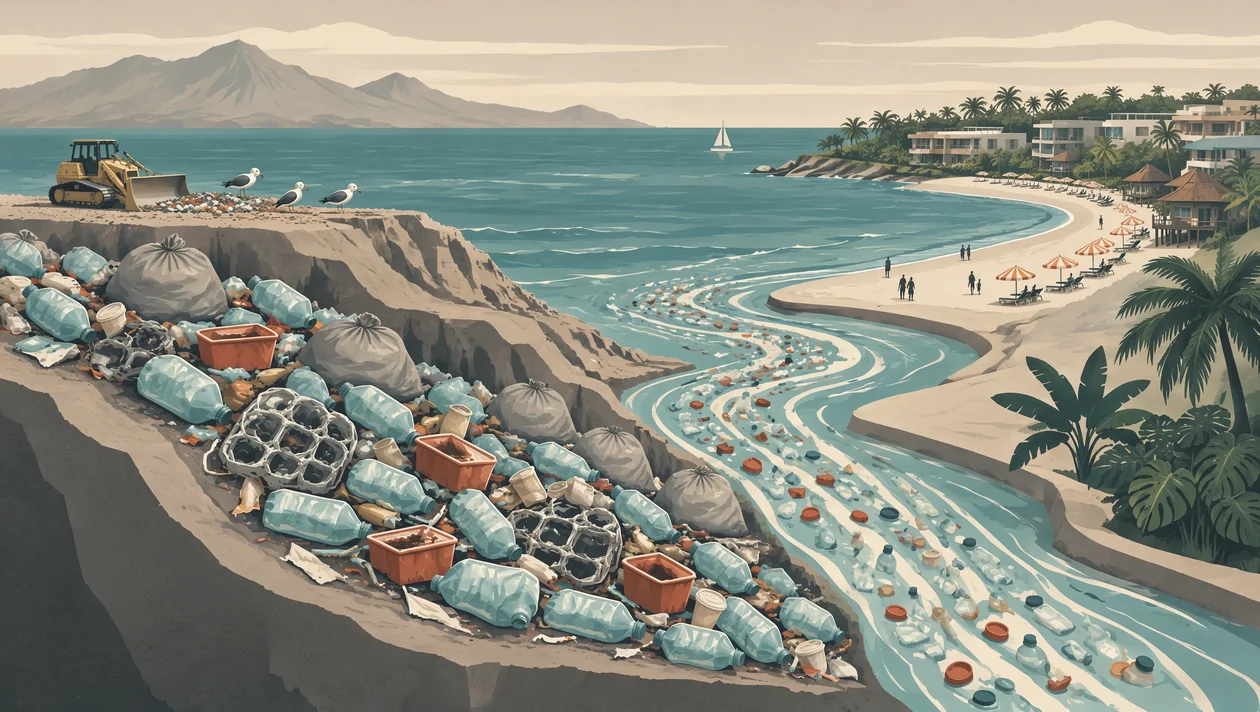
Bali and Mexico are both postcard economies with a landfill problem. The numbers are similar enough to be a warning, and different enough to show what actually changes them.
The global baseline
The World Bank's What a Waste 2.0 put global municipal solid waste at 2.01 billion tonnes a year, with at least 33 % not managed in an environmentally safe way. Of that total, roughly 13.5 % is recycled and 5.5 % composted. On current trends the annual figure reaches 3.4 billion tonnes by 2050, and most of the growth is in low- and middle-income countries — the same places where tourist economies concentrate.
Two destinations make the pattern concrete: Bali, where tourism and waste generation rise together, and Mexico, where collection works far better than disposal.
Bali: 1.25 million tonnes a year
Indonesia's national waste information system (SIPSN) recorded 1,254,235 tonnes of waste generated in Bali in 2024 — around 3,400 tonnes a day across the island. Denpasar is the single largest contributor, and the Badung regency alone reported 547–600 tonnes a day in 2024.
Almost all of it converges on TPA Suwung, the landfill beside Denpasar. It operates as an open dump: waste is stacked without engineered containment, the pile has grown to roughly 40 metres — the height of a ten-storey building — and it has been over capacity for years. Leachate and odour problems are documented, and the site has been scheduled for permanent closure, leaving regencies without an alternative site.
This is the structural problem in a tourism economy: the waste arrives at the rate of the visitor economy, but the disposal system was sized for a pre-tourism island, and no one wants the next landfill in their village.
Mexico: collection is not recycling
Mexico's environment ministry (Semarnat) reported 120,128 tonnes of urban solid waste a day in its 2020 diagnostic — about 0.94 kg per person per day — with later estimates nearer 140,000 tonnes. Collection reaches most urban households; what happens afterwards is the gap. Independent analysis puts the recycling rate at roughly 9.6 %, with more than 85 % of municipalities lacking adequate separation and final-disposal infrastructure.
The Mexican case is instructive because it isolates the failure: it is not that rubbish is never picked up, it is that it is picked up, mixed, and tipped. Once materials are co-mingled in a truck, the economics of recovery collapse. A collection system without separation is a landfill delivery service.
Why this lands in your water
Open dumping does not stay on the dump. Rain percolating through mixed waste produces leachate — a liquid with high organic load, heavy metals and, in modern waste, plastic particles — which moves into shallow groundwater. In Bali, where many villas and compounds draw from shallow bores, that groundwater is also the drinking-water source.
The link to what comes out of the tap is direct: plastic waste that enters surface water fragments into micro- and nanoplastics, and groundwater near unlined dumps carries both the chemistry and the particles. Filtration can remove them from the water — but no filter addresses the dump.
What actually moves the number
- Separate at source. Organic waste is roughly half of the stream in both countries. Composting it locally halves what has to be transported — and removes the wet fraction that creates leachate.
- Community processing (the TPS3R model in Indonesia). Village-scale sorting and composting facilities work where central landfills do not, and they keep the material close to where it is generated.
- Make producers pay. Extended producer responsibility and deposit-return schemes move the cost of packaging to the party that chose it. Where they exist, recovery rates rise sharply.
- Price the visitor economy. A tourist generates several times the waste of a resident. A transparent tourism levy that funds collection capacity is less visible than a landfill fire and considerably cheaper.
- Cap the landfill properly. Where a site must stay open, engineered lining and leachate capture are the difference between a contained problem and a groundwater one.
None of this is a filtration problem, and it would be dishonest to present a water system as an environmental fix. What a whole-house filter does is protect one household from the consequences while the larger system is being rebuilt.
References
World Bank, What a Waste 2.0: A Global Snapshot of Solid Waste Management to 2050, 2018. SIPSN (Sistem Informasi Pengelolaan Sampah Nasional), Bali provincial data, 2024. Semarnat, Diagnóstico Básico para la Gestión Integral de los Residuos, 2020. IKI Alliance, Changing the Paradigm of Municipal Solid Waste Management in Naucalpan, Mexico. Bali Post and Denpost reporting on TPA Suwung capacity and closure, 2025.
Protecting a property while the system catches up
Whole-house filtration for villas and hotels drawing on shallow groundwater or municipal supply.